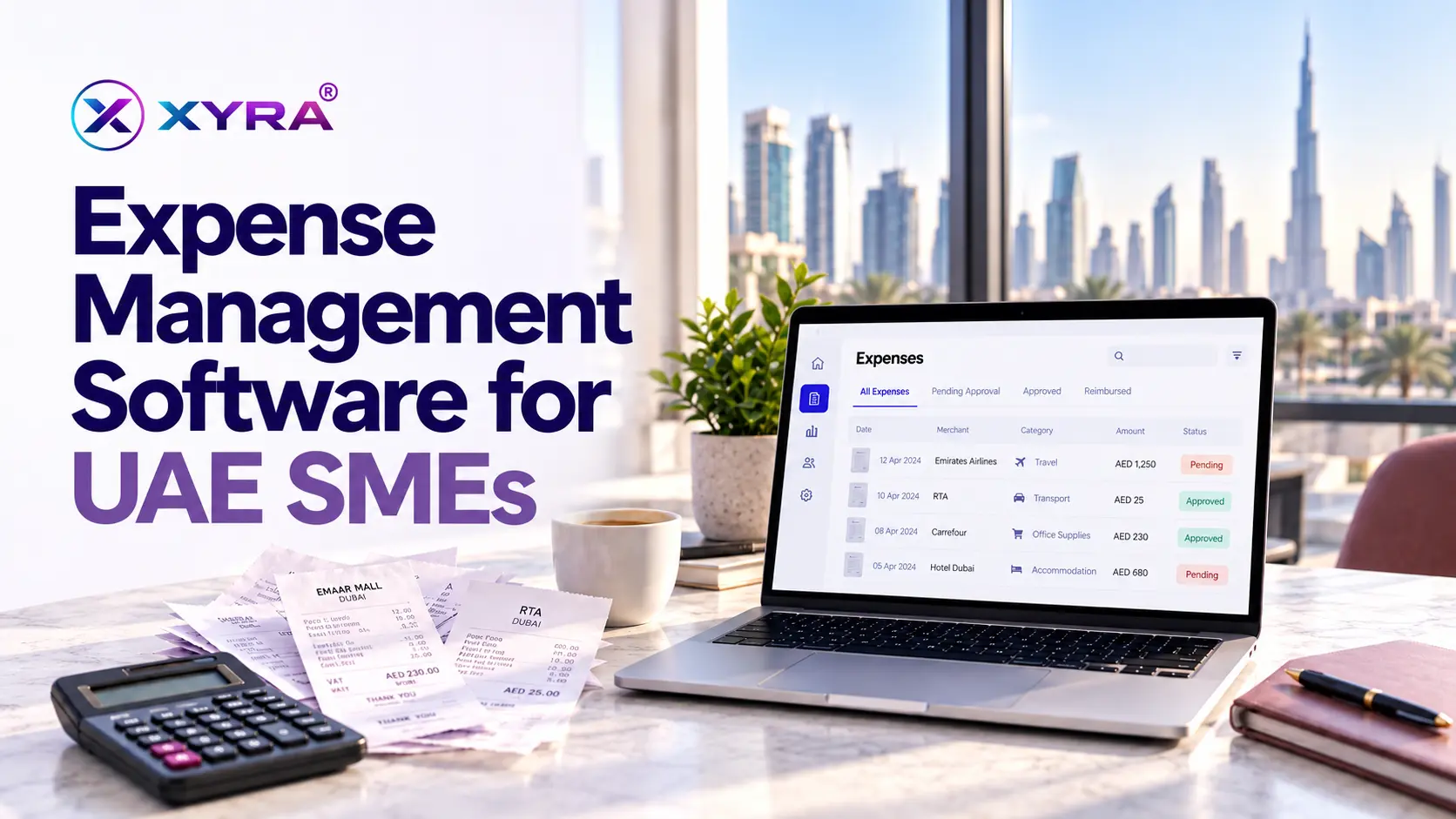
It's month-end at a 20-person trading company in Al Quoz. The sales manager hands the accountant an envelope of fuel slips, Careem receipts, a Salik statement and a crumpled lunch bill. Two receipts have faded, one has no tax number, and the books close in three days.
Many UAE small businesses still run expenses this way, on spreadsheets, WhatsApp photos and a petty cash box. With yearly corporate tax returns and mandatory e-invoicing from 2027, that no longer works. This guide explains what expense management software does, what manual work really costs, and how MSMEs and SMBs (micro, small and medium-sized businesses) can choose the right business expense management tools.
Table of Contents
- What Is Expense Management Software?
- Why Expense Management Matters More for UAE SMEs in 2026
- The Real Cost of Managing Expenses Manually
- Key Features to Look For in Expense Management Software
- How Expense Management Software Works
- Which UAE Businesses Benefit Most?
- How to Choose the Right Expense Management Software in the UAE
- Where the Expense Management Market Is Heading
- Get Your Expenses Audit-Ready Before 2027
- FAQs
What Is Expense Management Software?
Expense management software helps a business record, approve, repay and report its spending in one place. It replaces paper receipts and spreadsheets, and handles employee expense management, from travel and fuel claims to petty cash and company card spending.
An employee photographs a receipt, the app reads the amount, date and shop name, and the manager approves it on their phone. Finance pays the employee back, and the expense goes straight into the accounting system. That's automated expense tracking, with a clear record of every dirham that leaves the business.
Why Expense Management Matters More for UAE SMEs in 2026
A box of paper receipts used to be enough for many small UAE businesses. Not anymore. SMEs now carry more of the economy, the tax rules ask for better records, and e-invoicing becomes mandatory in 2027.
Together, these changes make small business expense management part of staying compliant and avoiding fines.
1. SMEs Carry the Non-Oil Economy
SMEs make up more than 94% of UAE businesses and about 63.5% of non-oil GDP, and the government wants one million SMEs by 2030. Non-oil activity made up 79.2% of the economy in the first half of 2026, according to the Federal Competitiveness and Statistics Centre.
2. The Tax Rules Now Reward Good Records
VAT is 5%, and VAT records must be kept for five years. Corporate tax is 9% on taxable income above AED 375,000, and those records must be kept for seven years. Missing records can bring an AED 10,000 fine from the Federal Tax Authority (FTA).
In August 2026, Ministerial Decision No. 131 extended Small Business Relief to tax periods ending on or before 31 December 2029, for businesses with revenue up to AED 3 million. They still have to register, file returns and keep records.
3. E-Invoicing Arrives in 2027
Businesses will soon send and receive invoices as structured digital files, whether or not they're registered for VAT. The rollout is phased by annual revenue:
| Phase | Who It Covers | Appoint an ASP By | Mandatory From |
|---|---|---|---|
| Phase 1 | Annual revenue of AED 50 million or more | 30 October 2026 | 1 January 2027 |
| Phase 2 | Annual revenue below AED 50 million | 31 March 2027 | 1 July 2027 |
| Phase 3 | Government entities | 31 March 2027 | 1 October 2027 |
Each business must appoint an Accredited Service Provider (ASP), an approved company that exchanges UAE E-Invoices on its behalf. Missing the deadline costs AED 5,000 a month. Most SMEs fall into Phase 2.

The Real Cost of Managing Expenses Manually
Handling expenses by hand feels free because there's no software bill. But every paper claim takes time to fill in, check, approve, correct and file.
Small mistakes, like a wrong amount or a lost receipt, also add up over a year and make tax filing harder.
The GBTA Foundation found that one expense report costs USD 58 and takes 20 minutes to process. About 19% have errors, and each fix costs another USD 52 and 18 minutes. SAP Concur says automation can cut this below USD 10 per report. For a typical Dubai SME, at AED 3.6725 to the dollar:
- Team size: 25 employees, two claims a month each, or 600 claims a year
- Processing cost: 600 claims × AED 213 = about AED 127,800
- Error correction: 114 claims × AED 191 = about AED 21,800
- Time lost: around 234 hours, nearly six working weeks
That's about AED 150,000 a year. GBTA's figures are global averages, so yours may be lower, but even half is money better spent on growth.
There's also lost VAT. Every AED 10,000 you spend includes about AED 476 of VAT you may be able to claim back. Without a clear receipt showing the supplier's Tax Registration Number (TRN), that gets hard.
Key Features to Look For in Expense Management Software
Not all expense management software UAE companies try is built for 5% VAT, TRN details or Arabic receipts.
Before comparing prices, check that the software covers these basics.
1. Receipt Scanning with OCR
Good receipt tracking software uses OCR (optical character recognition) to read receipt photos in English and Arabic, and saves each image for FTA audits.
2. Approval Workflows and Expense Policy Controls
Set spending limits by role or expense type. The system flags claims that break the rules, and managers approve from their phones.
3. UAE VAT-Ready Expense Data
The software should separate the 5% VAT and record the supplier's TRN on every claim, which makes VAT returns easier.
4. Multi-Currency Spending
Spending on trips to Riyadh, Mumbai or London should convert to AED at real-time exchange rates, with the original amount kept on record.
5. Corporate Cards and Petty Cash Management
Track cash, prepaid cards and company cards in one place for a single view of spending.
6. Accounting Software Integration
Approved expenses should flow into your UAE VAT-compliant accounting software, such as Zoho Books, QuickBooks, Xero, Tally or Odoo, without retyping.
7. Real-Time Expense Reporting
Live dashboards show spending by employee, department or project during the month, not weeks later.
How Expense Management Software Works
With business expense tracking software, every expense follows the same path, from purchase to your accounts.
Employees submit, managers approve, and finance checks and pays. Nobody has to chase paper.
- Capture: Photograph the receipt, or a card payment appears automatically.
- Submit: Send the claim through the app, tagged to a project.
- Approve: The manager checks it against company rules.
- Verify: Finance checks the VAT details and documents.
- Reimburse: The employee is paid by bank transfer or payroll.
- Report: The data flows into your accounts and tax filings.
Which UAE Businesses Benefit Most?
Any business that spends beyond its fixed monthly bills can benefit, especially one with staff on the road or buying supplies on the spot.
Some UAE businesses see the difference faster:
- Micro and small businesses: Owners using Small Business Relief still need proof of revenue and costs.
- Trading and distribution companies: Trade is the biggest part of non-oil GDP, at 16.2%, and sales teams create claims daily.
- Construction and contracting firms: Linking each site purchase to a project shows the true cost of every job.
- Hospitality, F&B and retail: Petty cash across several outlets needs tight control.
- Free zone startups: Founders can see cash going out as it happens.
- Accountants and outsourced bookkeepers: Digital records mean a faster month-end close.
How to Choose the Right Expense Management Software in the UAE
The right expense management software for UAE businesses depends on your team size, how you spend and your accounting system. A five-person startup doesn't need what a 200-person contractor does.
List your biggest problems first, such as lost receipts or slow VAT returns. Then check for:
- A mobile app your team will actually use, with native AI-assistant support
- UAE VAT handling, including the 5% split and TRN capture
- E-invoicing readiness and compatibility with your chosen ASP
- Integration with your accounting software or ERP
- Data security that follows the UAE's Personal Data Protection Law
- Clear AED pricing that grows with your team
- Local support during UAE working hours
A free trial with your own receipts will tell you more than any sales demo.
Where the Expense Management Market Is Heading
The UAE expense management software market was worth about USD 113 million in 2025 and is expected to reach USD 125.9 million in 2026, according to Next Move Strategy Consulting. The UAE also leads the wider Middle East and Africa market. AI in accounting drives much of this growth. Newer AI accounting software sorts spending, spots duplicate claims and flags unusual payments, so finance teams spend less time typing.
Get Your Expenses Audit-Ready Before 2027
For UAE SMEs, expense management is now part of staying compliant. Clean records protect your VAT claims and prepare you for corporate tax and e-invoicing.
Start with receipts and approvals, then add accounting links and company cards. The right software won't run your business, but it will show you where every dirham goes.
FAQs
1. Is expense management software mandatory in the UAE?
No, but accurate records are. VAT records must be kept for five years and corporate tax records for seven, and software makes that easy.
2. Do businesses under Small Business Relief still need to track expenses?
Yes. They must still register, file returns and keep records proving they qualify.
3. Will e-invoicing replace expense management software?
No. E-invoicing covers business and government invoices. Employee claims, petty cash and shop receipts still need managing.
4. How much does expense management software cost?
Most tools charge a monthly fee per user. Compare that with manual processing, which can cost around AED 213 per claim.
5. Is it worth it for a business with fewer than 10 employees?
Usually, yes. If you claim VAT back or use Small Business Relief, expense tracking software for small business owners keeps your records clean from day one.
6. Can expense management software help with corporate tax?
Yes. It links every receipt to its expense and can tag costs that are treated differently, such as client entertainment, which is only 50% deductible.
7. Can the software read Arabic receipts?
Many tools can, but quality varies. Test it with your own Arabic receipts during a free trial.
8. Is my business data safe in an expense management app?
Look for encryption, role-based access, ISO 27001 certification and clear answers on where your data is stored.